Time travel romance is the genre of love on the wrong side of the clock. Two people meet, fall, and choose each other — but one of them belongs to another century, ages at a different speed, or can only reach the other through a doorway that may never open again. The romance is real. So is the arithmetic, and the arithmetic is almost never in the lovers' favor.
That tension is why the genre has endured for more than a thousand years, long before anyone called it science fiction. Irish, British, Scottish, and Japanese folklore all tell of mortals who spend a few enchanted days with an otherworldly lover and return to find that centuries have passed. Modern bestsellers like Outlander and The Time Traveler's Wife are the newest branches of a very old tree.
Table of Contents
Time Travel Romance is fiction in which a central love story is shaped by time displacement — lovers separated by centuries, joined by a portal, or bound to worlds where time moves at different speeds. Whether the mechanism is magic, science, or never explained, the genre's defining question is the same: what would you give up to be with someone, when the price is paid in time?

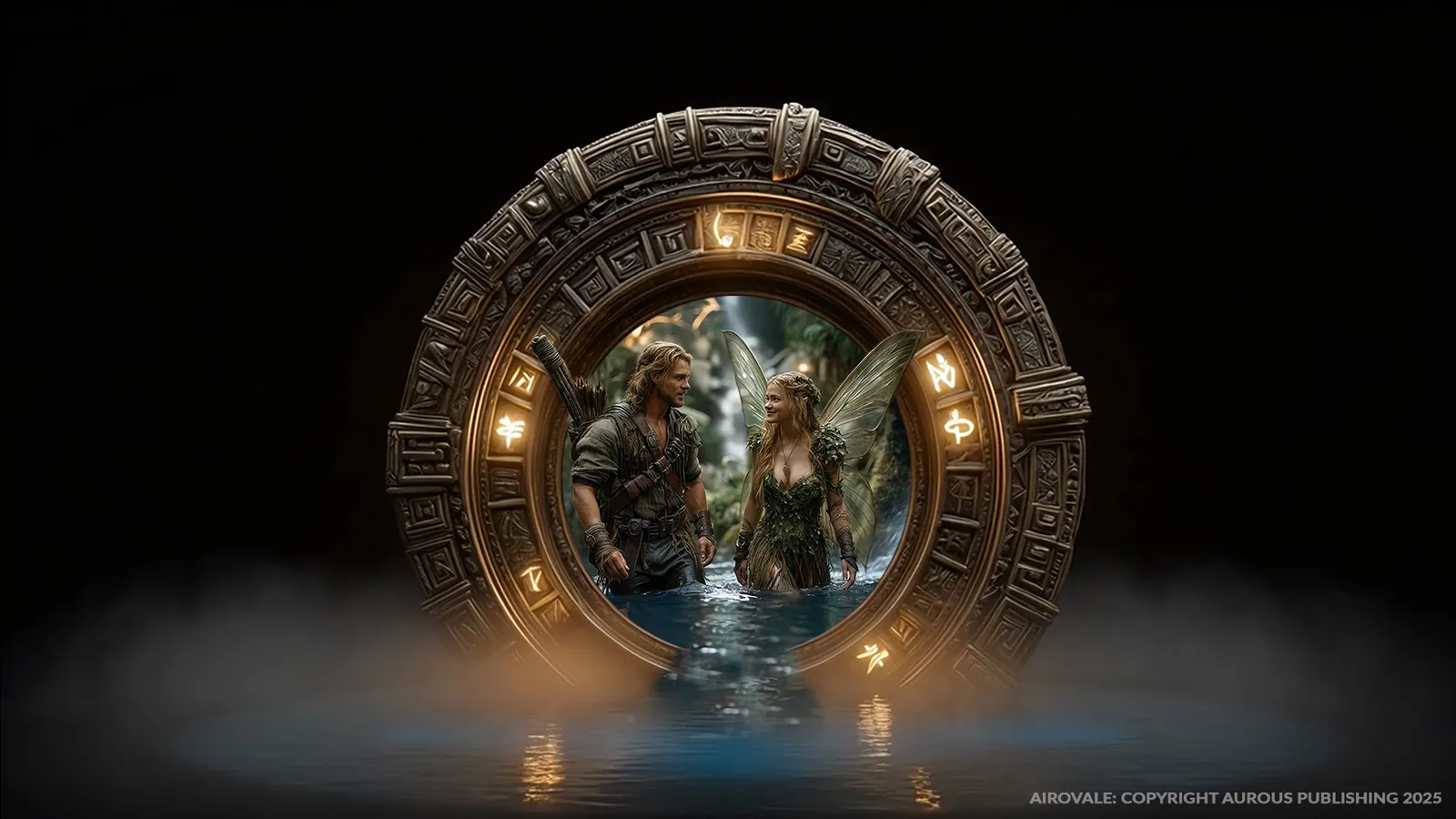
A human aeronaut and a fae woman explore a drowned city where time runs differently — from Airovale by Jef Gray
Origins: Fairy Time and the Oldest Time Travel Romances
Love in the Otherworld
Long before time machines, storytellers had a reliable way to move a hero through time: send him to the realm of the fae. Folklorists catalog this as the motif of the supernatural lapse of time in fairyland (F377 in Stith Thompson's Motif-Index of Folk-Literature) — a few days of feasting, music, or love among otherworldly beings equal years, sometimes centuries, in the mortal world.
Many of these tales are romances at heart:
- Oisín and Niamh (Irish) – The poet-warrior Oisín follows the fairy princess Niamh to Tír na nÓg, the Land of Youth. What seems like three years passes; when he returns to Ireland, three hundred years have gone and everyone he knew is dust. The moment his foot touches mortal soil, the years catch up with him.
- Urashima Tarō (Japanese) – A young fisherman is carried to the undersea Dragon Palace and the princess Otohime. After a few idyllic days he returns home to a village where no one remembers him — centuries have passed. Opening the box she gave him releases his stolen years at once.
- Thomas the Rhymer (Scottish) – Thomas is taken by the Queen of Elfland and serves her for what feels like three days. Seven years have passed when he returns to the world above.
- King Herla (British) – In Walter Map's twelfth-century De Nugis Curialium, King Herla attends a wedding feast in a dwarf king's hall for three days and emerges to find that two centuries have gone by.
The Pattern Beneath the Myths
These stories share a structure that modern time travel romance still follows: an irresistible otherworldly love, a place where time runs at a different rate, a return that reveals the true cost, and a rule — never touch the ground, never open the box — that cannot be broken without paying the whole debt at once.
From Folklore to Fiction
The nineteenth century gave the idea a scientific costume. Washington Irving's "Rip Van Winkle" (1819) borrowed the fairy-sleep plot for an American audience; Mark Twain's A Connecticut Yankee in King Arthur's Court (1889) sent a modern man back to Camelot; and H.G. Wells's The Time Machine (1895) gave the world a device to do the work magic once did.
The romance came back to the center in the twentieth century. Jack Finney's Time and Again (1970) and Richard Matheson's Bid Time Return (1975) — filmed as Somewhere in Time (1980) — made love the reason to cross the years. Jude Deveraux's A Knight in Shining Armor (1989) and Diana Gabaldon's Outlander (1991) turned time slip romance into one of the most popular categories in publishing.
Defining Characteristics
A Love Story at the Center
Time travel can appear in thrillers, science fiction, and literary fiction without any romance at all. A time travel romance is one where the relationship is the spine of the story — the reason for the journey, the source of the stakes, or the thing the displacement threatens to destroy.
Time as the Obstacle
In most romances, the obstacle is social: family, rank, rivals, pride. In time travel romance, the obstacle is time itself. Common forms include:
- Separation across eras – Lovers born centuries apart, with only a fragile crossing between them
- Unequal aging – One partner ages normally while the other does not, or years pass for one while days pass for the other
- A closing door – A portal, stone circle, or window in time that will not stay open forever
- A debt that comes due – Borrowed time must be repaid, often all at once
- The world left behind – Family, children, or a whole life waiting on the other side of the choice
Rules and Consequences
The strongest time travel romances establish clear rules for how time works — and then make the lovers pay for them. Whether the mechanism is a standing stone, a genetic condition, a fae bargain, or a machine, readers want to understand the cost well enough to dread it. A rule that bends whenever the plot needs it drains the romance of tension.
Historical Immersion
Because one lover usually comes from another era, time travel romance often doubles as historical fiction. The sensory detail of the past — its clothing, dangers, manners, and injustices — becomes part of the courtship, and the time traveler's outsider perspective lets readers experience that world fresh.
Types of Time Travel Romance
"Time travel romance" covers several distinct kinds of stories. Readers who love one don't always love the others, so the distinctions are worth knowing.
Time Slip Romance
A modern character is pulled into the past — through a stone circle, an heirloom, a house, or a moment of crisis — and falls in love there. The heroine of Outlander passing through the stones of Craigh na Dun is the defining example. Time slip stories usually center on the question of whether to stay or return.
Time-Crossed Lovers
One or both lovers move through time involuntarily and out of order. Audrey Niffenegger's The Time Traveler's Wife (2003) is the landmark: a husband who vanishes into his own past and future, and a wife who meets him at every age. These stories are about loyalty across a relationship that can never happen in sequence.
Portal and One-Way Crossings
A doorway connects two times, but the crossing is rare, dangerous, or permanent. Once through, there may be no way back. The romance is shaped by the finality of the choice — every crossing is an exchange of one life for another.
Time Dilation and Fairy Time
No one travels to a different year. Instead, time moves at different speeds in different places, so the lovers age apart even while standing in the same moment. This is the oldest form of time travel romance (Oisín, Urashima Tarō) and one of the most modern, echoing relativistic science fiction like Joe Haldeman's The Forever War (1974) and the film Interstellar (2014).
Example: Airovale's Time Debt
In Airovale, a steampunk fantasy saga by Jef Gray, a zeppelin crew is marooned on Canyon Myst, a fae-guarded island where time moves differently — every day spent loading gold costs them a year at home. The island's ancient survivors arrived through a one-way portal that threw them a thousand years into the future, and their days now expire as years anywhere but the island. Against that ledger, a human crewman named Aden falls for Kira, a fae woman already betrothed to another. It is fairy time in its classic form: the love is real, and so is every year it costs.
The Immortal Lover
One lover doesn't age — through a curse, a gift, or a fae bloodline — and must watch the world move on without them. V.E. Schwab's The Invisible Life of Addie LaRue (2020) and Natalie Babbitt's Tuck Everlasting (1975) explore the loneliness of living outside time. The romance asks whether love is worth the grief that eternity guarantees.
Letters and Echoes Across Time
The lovers never share the same year at all; they communicate through letters, messages, or objects that pass between times. The Lake House (2006) and Amal El-Mohtar and Max Gladstone's This Is How You Lose the Time War (2019) turn correspondence itself into the courtship.
Quick Comparison
| Type | How Time Separates Them | Classic Example |
|---|---|---|
| Time Slip | One lover is from another century | Outlander |
| Time-Crossed | Meetings happen out of order | The Time Traveler's Wife |
| Portal / One-Way | A crossing that may not reopen | Kate & Leopold |
| Time Dilation / Fairy Time | Time runs at different speeds | Oisín and Niamh; Airovale |
| Immortal Lover | One lover never ages | The Invisible Life of Addie LaRue |
| Letters Across Time | They never share the same year | The Lake House |
Notable Works in Time Travel Romance
The genre spans centuries of folklore, decades of bestsellers, and some of the most beloved romantic films ever made. Here are significant examples:
Folklore and Early Classics
Oisín in Tír na nÓg
Urashima Tarō
Time and Again
Bid Time Return
Modern Bestsellers
A Knight in Shining Armor
Outlander
The Time Traveler's Wife
Shadow of Night
This Is How You Lose the Time War
The Invisible Life of Addie LaRue
One Last Stop
The Ministry of Time
Film, Television, and Transmedia
- Somewhere in Time (1980 film) – A playwright wills himself back to 1912 to meet the actress in an old photograph
- Kate & Leopold (2001 film) – A nineteenth-century duke falls through a portal into modern New York
- The Lake House (2006 film) – Two strangers fall in love through letters left in a mailbox two years apart
- About Time (2013 film) – A young man uses inherited time travel to win, and keep, the woman he loves
- Outlander (2014 TV series) – The long-running adaptation of Gabaldon's novels
- Airovale (2025) – A steampunk fantasy saga from Aurous Publishing where a forbidden human–fae romance unfolds on an island that charges a year for every day. Told as a novel, ten cinematic episodes, and an original soundtrack.
Why Time Travel Romance Resonates
Time Is Everyone's Real Obstacle
Few readers will ever fall through a stone circle, but everyone knows what it means to run out of time — with a parent, a partner, a child growing up too fast. Time travel romance makes that universal fear visible and gives it a shape the characters can fight.
The Weight of the Choice
Because the price is so high, the choice to love means more. A heroine who stays in the eighteenth century gives up everything modern life offers; a mortal who follows a fae lover gives up the world he knew. The sacrifice makes the romance feel earned rather than convenient.
Two Genres for the Price of One
Time travel romance offers the emotional payoff of romance alongside the immersion of historical fiction or the wonder of fantasy. Readers get a love story and a world — often two worlds — to explore.

The world left behind — a homecoming that reveals what the time away has cost, from the Airovale saga
Mortality, Gently Handled
At its core, the genre is about mortality: aging, loss, and what outlasts us. By wrapping those themes in adventure and longing, time travel romance lets readers sit with big questions without being crushed by them.
For Readers and Writers
What to Expect When Reading Time Travel Romance
- A love story that carries real weight in the plot, not a subplot
- At least one character out of place in time, seeing the world as an outsider
- A clear cost — years, family, a world left behind — attached to the relationship
- Rich period or otherworldly detail, often doubling as historical or fantasy fiction
- An ending that may be happy, bittersweet, or open — this genre is less bound to the guaranteed happily-ever-after than category romance
Key Elements for Writers
- Define the Rules Early – Readers forgive almost any mechanism if its limits are consistent
- Make Time Cost Something – Every crossing, every extra day, should be paid for in a currency the characters value
- Give Both Worlds a Pull – The choice only matters if the life left behind is worth missing
- Mind the Paradoxes – Decide whether the past can change, and hold to it
- Let the Romance Drive the Plot – If the love story could be removed without changing the ending, it isn't yet a time travel romance
Frequently Asked Questions
What is time travel romance?
Time travel romance is fiction in which a central love story is shaped by time displacement — lovers from different centuries, a portal between eras, or worlds where time moves at different speeds. The relationship drives the plot, and time itself is the main obstacle the lovers must overcome.
What is the difference between time slip and time travel romance?
Time slip romance is a type of time travel romance in which a character is pulled into another era — usually the past — by a place, object, or event rather than a machine, and often without choosing to go. Outlander is the best-known example. Time travel romance is the broader category, which also includes time-crossed lovers, one-way portals, fairy time, and immortal lovers.
What is fairy time?
Fairy time is a folklore motif in which time passes differently in the realm of the fae: a few days spent there can equal years or centuries in the mortal world. It appears in the Irish tale of Oisín and Niamh, the Scottish ballad of Thomas the Rhymer, and the Japanese legend of Urashima Tarō, and it is one of the oldest forms of time travel romance.
Is Outlander a time travel romance?
Yes. Diana Gabaldon's Outlander (1991) is widely considered the defining modern time slip romance: a World War II nurse passes through a Scottish stone circle into 1743 and falls in love with a Highland warrior.
What are good fantasy time travel romance books?
Popular choices include Diana Gabaldon's Outlander, Deborah Harkness's Shadow of Night, V.E. Schwab's The Invisible Life of Addie LaRue, and Amal El-Mohtar and Max Gladstone's This Is How You Lose the Time War. For a fairy-time story told as a novel, cinematic episodes, and soundtrack, Airovale by Jef Gray follows a forbidden human–fae romance on an island where every day costs a year at home.
Related Genre Guides
- What is Epic Fantasy Romance? – Forbidden love against world-scale stakes, from Beren and Lúthien to fae romantasy
- What is Steampunk Fantasy? – Airships, brass, and magic: the aesthetic behind many time-bending adventures
- What is Medieval Romance? – The chivalric tradition that gave us the fairy lovers of Arthurian legend
- Medieval Romantasy – Adult historical romance set in the Middle Ages, the destination of many time slip heroines
Further Resources
- Goodreads Time Travel Romance Shelf – Reader-curated lists and recommendations
- The Encyclopedia of Science Fiction: Time Travel – The history of time travel in fiction
- The Encyclopedia of Science Fiction: Timeslip – Definitions and examples of the timeslip tradition
- Diana Gabaldon's Official Site – The author of Outlander on her series
Conclusion
Time travel romance endures because it dramatizes the one thing no lover can outrun. From Oisín riding home to a world three hundred years older to a modern heroine choosing between centuries, the genre turns time into the obstacle, the currency, and the measure of love.
Whether you're drawn to Highland time slips, fae bargains, one-way portals, or islands where a day costs a year, time travel romance asks the question every love story eventually faces: how much time do we have — and what are we willing to trade for more of it?